以下為Sunny的英文導覽筆記
Xinpú Township in Hsinchu County is the hometown of my childhood, where my grandparents spent most of their lives. After my grandfather passed away when I was in the second grade of elementary school, my parents and I moved back from Hsinchu City to Xinpú, returning to the place where so many of my earliest memories were born.
Not long ago, I was given the opportunity to work as an English guide in this small town. While researching its historic “three streets, six alleys, and nine ancestral halls,” I realized how little I had truly explored the lovely hometown I thought I knew so well.
Although there are many travel writings in Chinese—scattered and fragmentary—English introductions to Xinpú are surprisingly rare.
That absence inspired me to turn my study notes into something lasting—to record what I have uncovered, so that more people, especially visitors from overseas, may come to know and appreciate the quiet beauty and rich heritage of Xinpú.
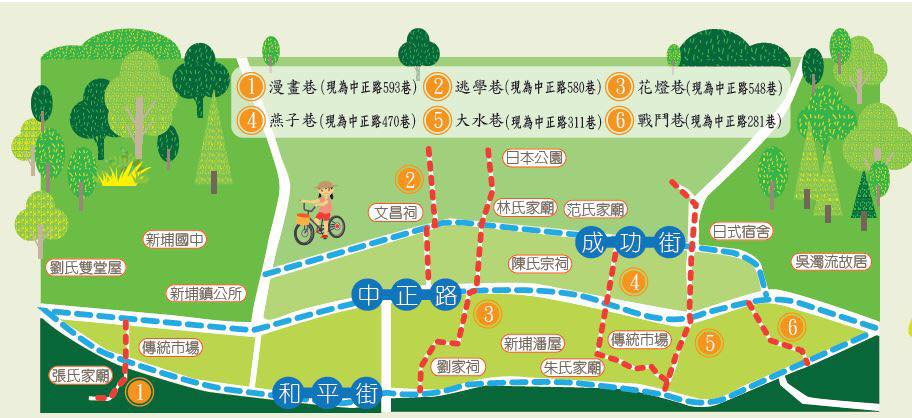
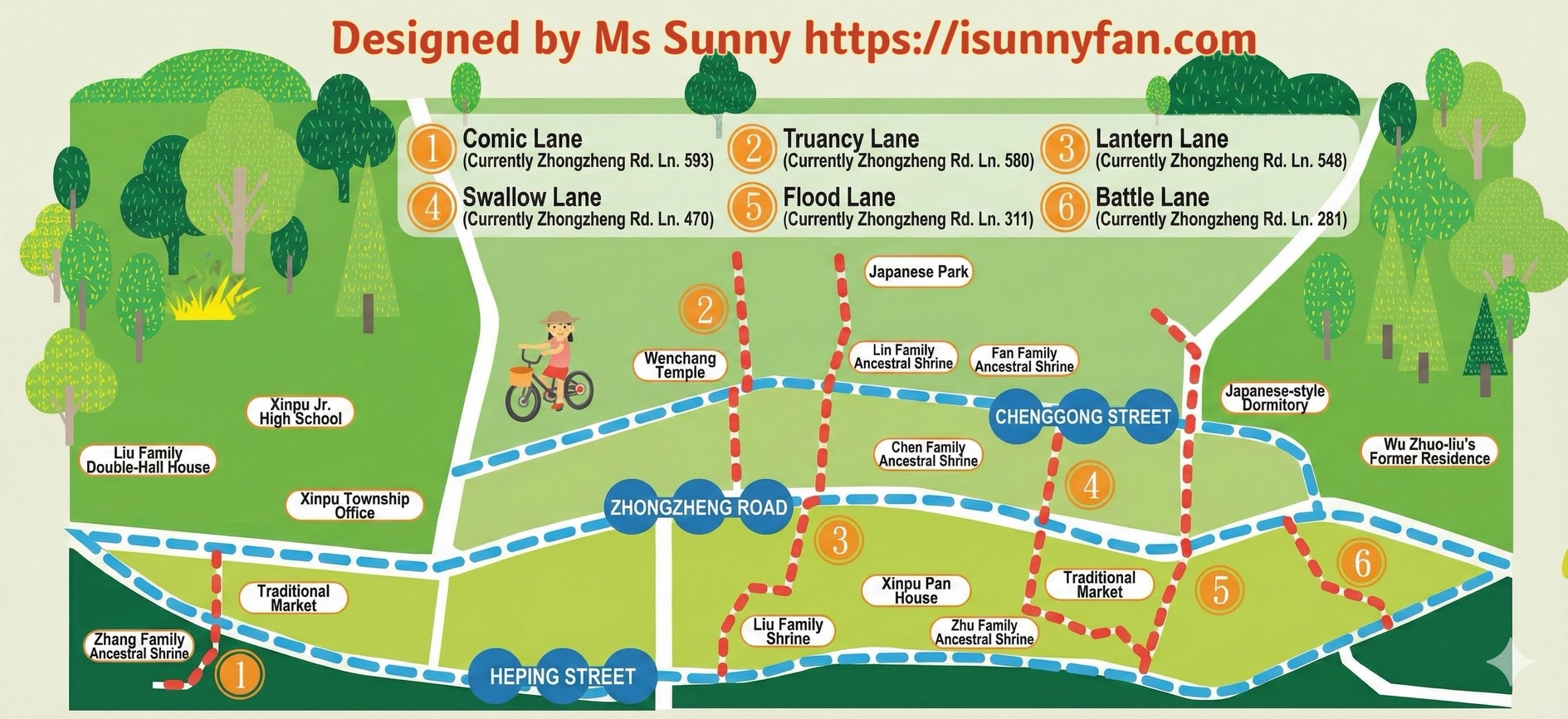
The Xinpu Ancestral Hall Museum is not a single building, but rather a collection of nine ancestral halls and family temples spanning three streets and six lanes. It is a museum without walls in Xinpu Town, showcasing not only the beauty of Hakka ancestral hall architecture but also the rich and diverse Hakka culture, allowing visitors to recall the historical prosperity of each family through the ancestral halls.
Hsinpu Township was formerly known as “Bali Gou,” originally inhabited by the Pingpu indigenous people.meaning “new grassland.” During the Qing Dynasty, Hakka ancestors from Guangdong settled there and the area was renamed “Xinpu.”
Due to the booming development of commerce in the mid-19th century, wealthy families in the area built large mansions, which have been preserved as historical and Hakka-style buildings.
The Xinpu Ancestral Hall Museum was established in September 2016. It covers three central streets: Xinpu Heping Street, Zhongzheng Road, and Chenggong Street, and is connected by six alleys: Dashui Alley, Huadeng Alley, Manhua Alley, Yanzi Alley, Zhan Dou Alley, and Taoxue Town, creating a museum that represents the lifestyle of Hakka culture.
Among them, Heping Street has the Cheng Family Temple, Liu Family Temple, Xinpu Pan House, and Chou Family Temple; Chenggong Street has the Lin Family Temple and Fan Family Temple; Zhongzheng Road has the Chen Family Ancestral Hall. In addition, there are the Liu Family Double Hall and Wu Zhuoliu’s former residence in the surrounding area. There are a total of nine ancestral halls and family temples that are over a hundred years old. They are still well preserved and have historical and cultural significance.